
Quick Summary
- CBT 1 serves as a screening with 100 questions from Mathematics, General Intelligence and Reasoning, General Awareness and General Science.
- CBT 2 decides merit with 150 questions, including 100 marks from branch-specific Technical Abilities.
- Negative marking of 1/3 applies in both stages — confirm exact details in the latest official notification.
- Non-technical syllabus remains common while Technical Abilities vary by engineering discipline, such as Civil, Mechanical or Electrical.
- Balanced preparation across stages is essential since CBT 1 filters candidates for the high-weightage CBT 2.
Many engineering diploma and degree holders set their sights on a secure railway job through the RRB JE recruitment, only to feel overwhelmed by the sheer volume of the technical syllabus and the two-stage CBT structure. The screening in CBT 1 demands speed across general subjects, while CBT 2 tests deep branch-specific knowledge that carries two-thirds of the merit weightage. Aspirants often waste months treating both stages the same way or underestimating the non-technical sections in CBT 2 that can still swing cutoffs. This guide draws from consistent patterns across recent recruitment cycles to give you the precise syllabus breakdown, exam structure and targeted preparation approach that actually works for Indian aspirants.
On this page
What is the RRB JE Syllabus
RRB JE Syllabus refers to the complete set of topics tested in the Railway Recruitment Board Junior Engineer recruitment exam across its two computer-based test stages. It assesses candidates on general aptitude, basic sciences, computer and environmental awareness, plus in-depth technical knowledge aligned with the engineering discipline chosen at application. The syllabus helps engineering graduates and diploma holders prepare for posts in Indian Railways that demand both theoretical understanding and practical application.
The exam pattern and syllabus details are outlined in the official Centralised Employment Notification released by RRB. CBT 1 functions primarily as a screening test, while CBT 2 forms the basis of final merit, along with document verification and medical examination. Confirm the current selection stages and any updates directly in the latest RRB JE recruitment notification or your regional RRB portal before starting preparation.
The structure ensures only candidates with solid fundamentals and strong technical command advance.
Reality check: Many aspirants assume the syllabus mirrors their diploma curriculum exactly and skip revision of core topics. In practice the questions test application-level understanding rather than rote memorisation, especially in the 100-mark Technical Abilities section.
RRB JE Exam Pattern
The RRB JE selection process involves two computer-based tests followed by document verification and medical examination. CBT 1 acts as a qualifying screening round while CBT 2 carries the primary weight for merit list preparation.
Since no single official notification URL was available in the reference sources, the pattern described here reflects the widely consistent structure from recent cycles. Confirm the exact number of questions, duration, qualifying marks and any revisions in the current official notification released by RRB.
Typical CBT 1 pattern (100 questions, 90 minutes):
- Mathematics: 30 questions
- General Intelligence and Reasoning: 25 questions
- General Awareness: 15 questions
- General Science: 30 questions
Typical CBT 2 pattern (150 questions, 120 minutes):
- General Awareness: 15 questions
- Physics and Chemistry: 15 questions
- Basics of Computers and Applications: 10 questions
- Basics of Environment and Pollution Control: 10 questions
- Technical Abilities (branch-specific): 100 questions
Negative marking of 1/3 mark applies for every wrong answer in both stages. Minimum qualifying marks are category-wise (usually 40 per cent for UR/EWS, with relaxations for reserved categories). Normalisation is applied when the exam is conducted in multiple shifts.
Tip: Attempt only questions you are reasonably sure about in both stages. The negative marking can quickly erode your score even if you attempt 70–80 per cent correctly.
Subject-Wise Syllabus for CBT 1
CBT 1 tests foundational knowledge that screens candidates for the merit stage.
Mathematics covers topics at the 10th–12th standard level, including number systems, BODMAS, decimals and fractions, LCM and HCF, ratio and proportion, percentages, mensuration, time and work, time and distance, simple and compound interest, profit and loss, algebra, geometry, trigonometry, elementary statistics, square root, age calculations, calendar and clock, and pipes and cisterns.
General Intelligence and Reasoning includes analogies, alphabetical and number series, coding and decoding, mathematical operations, relationships, syllogism, jumbling, Venn diagram, data interpretation and sufficiency, conclusions and decision making, similarities and differences, analytical reasoning, classification, directions, and statement-arguments and assumptions.
General Awareness focuses on current affairs, Indian geography, culture and history of India, including the freedom struggle, Indian polity and constitution, Indian economy, environmental issues concerning India and the world, sports, and general scientific and technological developments.
General Science draws from Physics, Chemistry and Life Sciences up to the 10th standard CBSE syllabus.
Subject-Wise Syllabus for CBT 2 (Non-Technical Sections)
CBT 2 non-technical sections carry 50 marks, but often decide cutoffs when technical scores are close.
General Awareness mirrors CBT 1 with emphasis on current events and railway-related developments.
Physics and Chemistry tests concepts at the 12th standard level, with some overlap from 10th standard topics.
Basics of Computers and Applications covers computer architecture, input and output devices, storage devices, operating systems (Windows, Unix, Linux), MS Office, internet and email, websites and web browsers, networking, and computer viruses.
Basics of Environment and Pollution Control includes basics of environment, adverse effects of pollution and control strategies, types of pollution (air, water, noise), waste management, global warming, acid rain and ozone depletion.
Technical Abilities Syllabus (Branch-Specific)
The 100-mark Technical Abilities section in CBT 2 is the heaviest and most decisive. Topics align with the engineering discipline chosen at application (Civil & Allied, Mechanical & Allied, Electrical & Allied, Electronics & Allied, etc.).
Common branches include detailed coverage of core subjects such as Engineering Mechanics, Building Materials and Construction (for Civil), Strength of Materials, Thermodynamics and Fluid Mechanics (for Mechanical), Circuit Theory, Machines and Power Systems (for Electrical), and Electronic Devices, Digital Electronics and Communication (for Electronics).
Candidates should refer to their diploma or degree curriculum for precise topics. The official notification provides detailed annexures for each discipline.
One observation that recurs across aspirant discussions is that candidates who revise directly from their engineering textbooks and previous year question papers perform noticeably better in this section than those relying solely on general coaching notes.
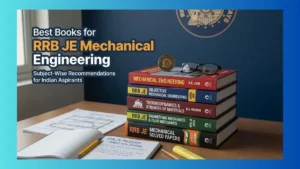
Best Books and Study Materials for RRB JE
These resources surface consistently in successful candidates' lists and toppers' recommendations.
- Quantitative Aptitude by R.S. Aggarwal — S. Chand | Intermediate | Paid — Excellent for Mathematics practice with solved examples and a variety of questions; ideal for building speed in CBT 1 topics. Suits most aspirants but may feel basic for advanced problem solvers.
- A Modern Approach to Verbal & Non-Verbal Reasoning by R.S. Aggarwal — S. Chand | Intermediate | Paid — Covers almost every reasoning topic asked; community favourite for CBT 1 because of structured practice sets.
- Lucent's General Knowledge — Lucent | Beginner to Intermediate | Paid — Comprehensive one-stop book for General Awareness and current affairs updates; frequently cited by candidates who cleared in the first attempt.
- NCERT textbooks (Class 9–12 for Physics, Chemistry and Biology) — NCERT | Beginner | Free/Paid — Perfect foundation for General Science and Physics & Chemistry sections in both CBTs.
- Branch-specific diploma textbooks (e.g., Civil Engineering by B.C. Punmia or standard publishers) — Various | Advanced | Paid — Essential for Technical Abilities; recommended by serving engineers and cleared candidates for depth.
Realistic 3–6 Month Study Plan
| Month/Phase | Focus Topic | Priority Resources | Daily Time Suggestion |
|---|---|---|---|
| Month 1 | CBT 1 fundamentals (Maths, Reasoning, GS) | R.S. Aggarwal books + NCERT | 4–5 hours |
| Month 2 | CBT 2 non-technical + start Technical revision | Lucent GK + branch textbooks | 5–6 hours |
| Month 3–4 | Full Technical Abilities deep dive + PYQs | Discipline-specific books + previous papers | 6 hours |
| Month 5 | Mixed mock tests + weak area revision | Full-length mocks | 6–7 hours + analysis |
| Month 6 | Revision, current affairs and final mocks | Quick revision notes + daily GA | 5 hours |
Adjust according to your engineering background. Candidates with a strong technical base can compress the technical phase and allocate more time to CBT 1 speed building.
Common Mistakes and How to Avoid Them
Aspirants frequently treat CBT 1 and CBT 2 preparation in isolation and end up underperforming in the merit stage. Another recurring issue is random guessing due to over-attempting, which is heavily punished by negative marking. Many also ignore the 50 non-technical marks in CBT 2, thinking technical alone will suffice, only to miss the cutoff by a narrow margin.
Focus on previous year papers early, analyse normalisation impact across shifts, and maintain a balanced daily schedule that covers both stages simultaneously.
Frequently Asked Questions
What is the difference between RRB JE CBT 1 and CBT 2?
CBT 1 is a screening test with general subjects, while CBT 2 is the main merit-deciding paper that includes heavy Technical Abilities (100 marks). Only candidates clearing the CBT 1 cutoff advance to CBT 2.
Is the RRB JE syllabus the same for all engineering branches?
Non-technical sections are common, but the Technical Abilities syllabus changes according to the chosen discipline (Civil, Mechanical, Electrical, Electronics, etc.). Check the official notification annexure for your specific branch.
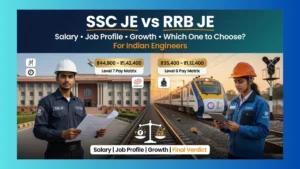
Can I prepare for RRB JE and SSC JE together?
Yes, there is significant overlap in non-technical and some technical topics. Focus on shared Mathematics, Reasoning, GA and basic science first, then branch out into railway-specific technical depth.
Which section carries the highest weightage in RRB JE?
Technical Abilities in CBT 2 with 100 marks out of 150. Strong command here is non-negotiable for a good merit rank.
How important are previous year papers for RRB JE?
Extremely important. They reveal the exact level and pattern of questions asked, especially in Technical Abilities.
What documents are needed for RRB JE document verification?
Original and self-attested copies of educational certificates, caste/income certificates (if applicable), identity proof and other documents listed in the official notification.
Is negative marking applicable in both CBT stages?
Yes, a 1/3 mark is deducted for every wrong answer in both CBT 1 and CBT 2.
Final Thought
The RRB JE syllabus rewards candidates who understand the two-stage structure rather than those who treat it like any other engineering exam. By mastering the common non-technical topics early and dedicating consistent effort to your branch-specific technical subjects, you give yourself a real edge over the lakhs of aspirants who apply every cycle. The key is starting with the right resources, practising under timed conditions and verifying every detail against the latest official notification.
You now have the complete roadmap. Put in the focused hours, track your progress weekly, and the railway Junior Engineer posting you have been aiming for is well within reach. Good luck with your preparation.