
Quick Summary
- SSC JE stands for Staff Selection Commission Junior Engineer, the main route for engineering diploma and degree holders into central government technical posts.
- The selection involves two computer-based papers focused heavily on core engineering subjects with negative marking.
- Pay starts at Level-6 of the 7th Pay Matrix with benefits including HRA that varies by city category.
- Eligibility requires specific educational qualifications and age limits that differ across departments like CPWD and BRO.
You have seen the abbreviation SSC JE pop up repeatedly while searching for stable government engineering jobs after your diploma or degree, and the confusion hits immediately. Is it just another SSC exam like CGL or CHSL? How does the full form connect to actual Junior Engineer roles in ministries and organisations? Most aspirants feel overwhelmed because the syllabus is branch-specific, competition runs into lakhs for limited vacancies, and official details on pattern and cut-offs keep changing between cycles. The fear of preparing for the wrong stage or missing department-specific requirements is real. This guide cuts through the noise with verified facts, a practical preparation strategy, and the exact realities Indian candidates face when targeting SSC JE.
On this page
What Does SSC JE Stand For?
SSC JE stands for Staff Selection Commission Junior Engineer. It is the recruitment examination conducted by the Staff Selection Commission for Junior Engineer posts in disciplines such as Civil, Mechanical, Electrical, and Quantity Surveying & Contracts across various central government departments and organisations. For engineering graduates and diploma holders in India, this exam represents one of the most direct pathways into Group B technical roles in prestigious bodies like the Central Public Works Department (CPWD), Military Engineer Services (MES), Border Roads Organisation (BRO), and others. Understanding the full form clarifies that SSC JE is not a school-level certificate but a competitive examination that determines your entry into responsible engineering positions with job security and structured career progression.
The exam attracts candidates who want the stability of central government service without the extreme competition of UPSC engineering services or the high GATE scores needed for PSUs. Yet many underestimate how much the technical paper weighs in final merit and how department preferences affect posting locations.
Reality check: SSC JE is not easier than other SSC exams just because it is engineering-focused — the core engineering section in both papers demands deep conceptual clarity, and negative marking in Paper-I punishes guesswork more than many expect.
Eligibility Criteria for SSC JE
Candidates must meet educational, age, and nationality requirements set by the Staff Selection Commission. Educational qualification typically involves a three-year diploma or a degree in the relevant engineering discipline from a recognised university or institution. For certain posts, two years of practical experience may also be required alongside the diploma. Age limits vary by department and post — generally between 18 and 27, 30, or 32 years as on the crucial date mentioned in the notification — with standard relaxations for reserved categories. [Verify: confirm current age limits, educational requirements, and department-specific relaxations in the latest official SSC notification on ssc.gov.in]
Nationality rules allow Indian citizens, along with certain categories of Nepalese, Bhutanese, and persons of Indian origin who have migrated from specified countries with the intention of permanent settlement in India.
For diploma holders: The reality is that while many departments accept diplomas, the competition from degree holders makes strong performance in the technical paper non-negotiable.
SSC JE Exam Pattern and Selection Process
The selection process for SSC JE consists of two computer-based examination papers. [Verify: confirm the current SSC JE tier structure, number of papers, marking scheme, and selection stages at the official portal ssc.gov.in before preparing — the pattern has been revised in recent cycles and competitor articles may reflect outdated information.]
Paper-I covers General Intelligence and Reasoning (50 questions, 50 marks), General Awareness (50 questions, 50 marks), and General Engineering (100 questions, 100 marks) for a total of 200 marks in 2 hours. Paper-II is dedicated to the candidate’s chosen branch of General Engineering (100 questions, 300 marks) in 2 hours. Negative marking applies — 0.25 marks per wrong answer in Paper-I and 1 mark per wrong answer in Paper-II. Candidates who qualify for Paper I appear for Paper II, after which the final merit is prepared based on performance in both papers. Document verification and medical examination follow for selected candidates.
The pattern places significant weight on the technical subjects, which is why many candidates who clear Paper-I comfortably still struggle with Paper-II.
Subject-Wise Syllabus Overview for SSC JE
The syllabus is divided into common sections and branch-specific technical content. General Intelligence and Reasoning tests analytical and logical abilities through topics like analogies, series, coding-decoding, and spatial visualisation. General Awareness covers current events, history, geography, polity, and scientific developments with emphasis on India and neighbouring countries.
The General Engineering section varies by branch:
- Civil & Structural Engineering includes building materials, surveying, soil mechanics, hydraulics, irrigation, transportation, environmental engineering, RCC design, and steel design.
- Electrical Engineering covers circuit theory, electrical machines, power systems, measurement, and basic electronics.
- Mechanical Engineering focuses on the theory of machines, thermodynamics, fluid mechanics, strength of materials, and production engineering.
[Verify: confirm the exact detailed syllabus for your branch in the latest official SSC notification.]
A common thread in aspirant discussions is that while reasoning and awareness sections are scoring, the real differentiator remains accuracy and depth in the engineering portion.
Subject-Wise Preparation Strategy for SSC JE
Start with a clear understanding of your chosen branch syllabus and allocate maximum time to technical subjects since they carry the heaviest weight. For General Intelligence and Reasoning, solve previous year papers daily to build speed — this section rewards consistent practice over rote learning. General Awareness requires regular reading of newspapers and static GK resources, focusing on government schemes, scientific research, and economic developments relevant to engineering contexts.
In the technical section, prioritise high-weightage topics such as RCC and steel design for Civil, machines and power systems for Electrical, and thermodynamics plus fluid mechanics for Mechanical. Make short notes of formulas, standard values, and key derivations because Paper-II tests application heavily. Solve at least 50–100 branch-specific questions daily and analyse every mock to identify recurring weak areas.
Tip: In SSC JE Paper-I, the sectional timing locks automatically once your allotted time for a section ends — plan your attempt order in advance rather than switching between sections mid-exam. [Verify: confirm current sectional timing in the latest exam instructions at ssc.gov.in]
Best Books and Study Materials for SSC JE
Standalone resources that deliver the best results for SSC JE preparation include a mix of conceptual clarity books and practice-oriented material.
- General Intelligence and Reasoning by R.S. Aggarwal — S. Chand | Intermediate | Paid The go-to book for building speed and accuracy through structured practice sets that mirror actual SSC JE questions.
- Lucent’s General Knowledge — Lucent Publications | Beginner to Intermediate | Paid Covers static GK comprehensively in a concise format, ideal for quick revision before the exam.
- SSC JE Civil Engineering Previous Year Solved Papers by Made Easy or similar — Made Easy Publications | Advanced | Paid Essential for understanding exact question trends and repeated topics across cycles.
- Objective Mechanical Engineering by R.K. Jain or branch-specific Made Easy objective books — Khanna Publishers / Made Easy | Intermediate to Advanced | Paid Excellent for concept building and high-volume practice required for Paper-II.
- SSC JE Electrical Engineering Guide by Disha Publications — Disha | Intermediate | Paid. Focuses on numerical problems and standard questions that appear frequently.
Free resources worth using include previous year question papers available on the SSC website and free mock test series from reputable coaching platforms.
Realistic 4-Month Study Plan for SSC JE
| Month | Focus Topic | Resource | Priority |
|---|---|---|---|
| Month 1 | Build foundation in core engineering subjects + daily reasoning practice | Branch-specific textbooks + R.S. Aggarwal | High |
| Month 2 | Complete syllabus coverage + start General Awareness | Technical notes + Lucent GK | High |
| Month 3 | Intensive practice of previous year papers and topic-wise mocks | Made Easy/Disha solved papers | High |
| Month 4 | Full-length mocks, revision of weak areas, and formula revision | Online mock test series | Highest |
Adjust the plan based on your current level — diploma holders may need extra time on conceptual topics, while degree holders can accelerate practice. Consistency of 5–6 hours daily beats weekend cramming, especially when balancing college or a job.
One observation that recurs across candidate communities is that those who treat Paper-II as the real decider, rather than over-focusing on Paper-I, tend to see better final ranks.
Salary, Pay Structure, and Career Growth in SSC JE
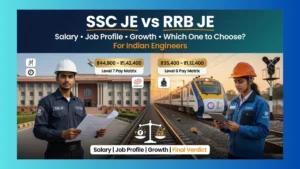
Selected candidates are placed in Pay Level-6 of the 7th Central Pay Commission with basic pay ranging from Rs. 35,400 to Rs. 1,12,400. The higher end of the in-hand salary applies to X-category cities (metros) due to higher House Rent Allowance, while Y and Z-category postings sit closer to the lower figure. Additional benefits include Dearness Allowance, medical facilities, transport allowance, and pension under the National Pension System. [Verify: confirm current salary structure, allowances, and pay level in the latest official recruitment notification.]
Career growth involves promotions to Assistant Engineer and Executive Engineer levels over time, with opportunities for inter-departmental transfers and central government perks. Many candidates view SSC JE as a stable launchpad that offers better work-life balance than private sector roles while still providing technical challenges.
Common Mistakes to Avoid in SSC JE Preparation
A frequent error is neglecting the technical Paper-II under the assumption that clearing Paper-I is enough. Another is ignoring negative marking, which significantly impacts scores when candidates attempt too many uncertain questions. Many also fail to analyse previous year cut-offs, branch-wise and department-wise, before deciding their target. Treating General Awareness as secondary or skipping regular mock test analysis leads to poor time management on exam day.
Frequently Asked Questions
What is the full form of SSC JE, and what posts does it recruit for?
SSC JE stands for Staff Selection Commission Junior Engineer. It recruits for Junior Engineer positions in Civil, Mechanical, Electrical, and Quantity Surveying & Contracts disciplines across central government departments such as CPWD, MES, BRO, and others.
What is the difference between SSC JE and RRB JE?
SSC JE offers central government postings with broader departmental options and Level-6 pay, while RRB JE is specific to Indian Railways. SSC JE generally has a different syllabus weightage and selection stages suited for various ministries rather than railway-specific operations.
Is SSC JE suitable for diploma holders or only degree holders?
Both diploma and degree holders can apply, depending on the specific post requirements mentioned in the notification. Diploma holders often need to check experience clauses for certain departments. [Verify: confirm exact eligibility for your qualification in the latest notification.]
What is the expected salary for SSC JE in India after selection?
Starting basic pay falls in Pay Level-6 (Rs. 35,400 – 1,12,400), with in-hand salary varying by city category due to HRA and other allowances. The higher end applies to metro postings.
Which branch has the highest competition in SSC JE?
Civil Engineering usually sees the highest number of applicants and therefore tougher cut-offs, followed by Mechanical and Electrical. Check branch-wise previous year cut-offs before finalising your strategy.
How many months of preparation are realistically needed to crack the SSC JE?
Three to six months of focused preparation is sufficient for candidates with a strong engineering background, provided they maintain daily practice and mock analysis. Diploma holders or working professionals may need the longer end of the spectrum.
Is SSC JE better than state AE exams for long-term career growth?
SSC JE provides central government service with nationwide transfer options and standardised pay, making it preferable for many over state-level posts that may offer limited growth or regional postings. The choice ultimately depends on your preference for central versus state service rules.
Final Thought
The confusion around the SSC JE full form and whether it is the right move for your engineering career ends here. You now have clarity on the exam structure, realistic preparation approach, and the actual job realities beyond the pay scale. If you are an engineering diploma or degree holder serious about central government stability, SSC JE remains one of the strongest options available. Pick your branch wisely based on vacancies and your strengths, commit to consistent technical practice, and verify every detail in the latest official notification before you begin. The path is demanding but leads to a respected, secure engineering role that thousands successfully secure every cycle. Start today with the resources and plan outlined — your government engineering career is closer than it feels right now.